Trending Topics

 Trending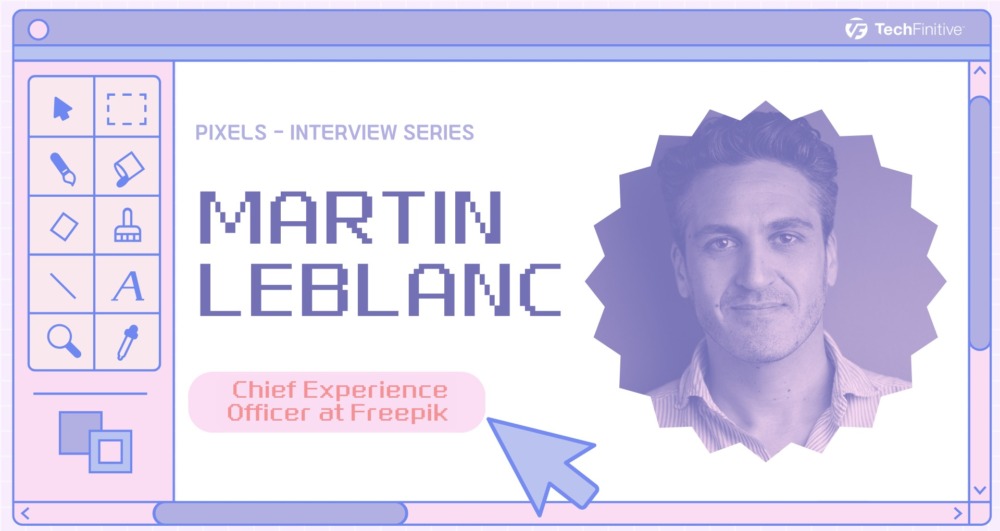
Martin LeBlanc, Chief Experience Officer at Freepik: “You should be thinking about technology and AI right at the beginning of the creative process”

If you’re unsure of how your business can embrace AI, read this interview with Martin LeBlanc, Chief Experience Officer at Freepik. “Working in the creative industry, everyone at Freepik understood people’s initial concerns about AI’s impact on design,” he told us, and we’re sure that included people at the company itself. Now, he describes Freepick as an “AI-first company”.
Keep reading and you’ll start to understand now just how and why Martin and the wider team embraced AI – and discover a hyper-realistic AI art generator in the process – but also the technology they use to keep them working closely together.
You’ll be familiar with Slack, but we were intrigued to discover what else the team uses. There’s Notion, another communication tool, and Linear to keep work organised. On the same theme, Martin uses PyCharm to organise code and the AI built into Cursor to help him create it. And, like so many others in our Pixels series of interviews with design industry names, there’s Figma “because of the collaboration aspect”.
This readiness to use new tools is reflected by Martin’s entrepreneurial career. Way back in 2007, he founded Iconfinder, which is still going strong today after it was acquired by Freepik in 2022. And he remains true to his developer past, still using CSS and HTML in design tasks.
But most of all he strikes as a technologist-for-business-good (we really need to think of a better term). And that’s most obvious in his approach to AI: “Those who don’t fear AI and embrace it will be miles ahead of their competitors and reap the rewards of better productivity, customer satisfaction and a streamlined workflow.” Keep reading for more insights like this – none of which were written by AI.
Related reading: Adrian Nistia, Brand & UI/UX Designer at Omniconvert: “The accessibility of software has allowed a larger number of people to explore design”
When thinking of your creative process, at what point does technology come in? What role does it play in different stages, from concept to final design?
You should be thinking about technology and AI right at the beginning of the creative process. But each project is different – sometimes AI will be used to help brainstorm or spark ideas, and other times it might be used to fine tune designs or even generate them altogether.
By mapping out where and when technology needs to come in, the whole process is smoother. That’s also what makes creating things so exciting. No two projects are ever the same. One of the most important attributes during any creative process is flexibility.
Technology can help us ‘go with the flow’, ensuring graphic designers, creatives, marketing teams and many more, can easily pivot towards a new strategy as quickly and efficiently as possible.”
What was the most challenging project you’ve worked on in which technology played a critical role?
The most challenging project was no doubt building Iconfinder, the company I founded and later sold to Freepik. Building web applications is significantly easier now, than ten to 15 years ago. Products like Stripe or Vercel weren’t around so pretty much anything had to be coded from scratch. This meant that you would spend your time on secondary things instead of focusing on building the product for your customers. Today, building products has become significantly easier. Now the challenge has moved to distribution.
Related reading: James Palmer, VP of Sales at Seismic: “AI doesn’t hinder human-to-human relationships in sales”
How has technology changed the way you collaborate at work? And in your view, has it improved or worsened navigating creative differences with clients or team members?
Unsurprisingly, technology has hugely changed the way I collaborate. At Freepik, we’re big believers in using tech to supplement our day-to-day work and streamline people’s productivity wherever we can. AI is also a core part of our business strategy and we want everyone to replace the potential fear of the unknown with curiosity.
Working in the creative industry, everyone at Freepik understood people’s initial concerns about AI’s impact on design – especially conversations around whether if it would make designers and artists redundant. That said, we also saw massive potential around how it would empower the industry, not replace it.
We integrated AI, not just into our products but into our strategy too. We’ve spent a lot of time fine-tuning how we align AI with our business goals and we’re now an AI-first company. A clear strategy and safe environment have helped us to navigate any creative differences within our team. We see challenging each other as a positive thing, as feedback leads you to the best ideas.
Generative AI art has taken the graphic design space by storm – what are your views on the use of tools like Stable Diffusion, Leonardo, Midjourney and others?”
I’m passionate about using generative AI to help users transform their creativity into a superpower. It propels creative minds to better articulate their concepts and opens the door to new ideas. Tools like Stable Diffusion, LeonardoAI and Midjourney have transformed the landscape but we’re pushing the industry further with our own solutions.
We recently released Freepik Mystic – an AI image generator that can create hyper-realistic images of people, objects and places, accurately follow prompts and generate realistic text on images. We developed Mystic with a team of photographers, digital artists, VFX specialists and designers to make sure we were creating a product that truly helped creatives. It’s a really exciting time to be in this space.

Related reading: Fabio De Bernardi, VP of Business Development at Adverity: “Having the right partner, whether it’s an agency or a reliable data stack, is essential”
With the rise of AI and automation in design, how do you see the role of a graphic designer evolving in the next few years?
Generative AI can create fantastic content and images, however, it is only as effective as the user behind it. The human touch will always be a vital part of the creative industry. Anyone who truly wants to harness the power of AI should ensure they have the right talent in the driver’s seat.
That said, AI is a tool – like the internet. It helps accelerate marketers, designers and creatives in achieving their goals. Practically speaking, graphic designers can do what they are best at, just much faster. This will raise the standard of graphics. Those who don’t fear AI and embrace it, will be miles ahead of their competitors and reap the rewards of better productivity, customer satisfaction and a streamlined workflow.
What tools or software do you find indispensable in your daily work, and why?
I’m a big fan of chat-based tools like Slack. They can be distracting, but when used right, eg with good naming patterns for channels, it can replace emails. The worst thing I know is a long email thread – it’s an incredibly inefficient way of communicating. So email is used for external communication only. Internally, I only use Slack.
For development tasks, I use PyCharm or Cursor depending on the coding tasks. PyCharm is amazing for organising the code. You can quickly code and catch errors. Cursor on the other hand has AI built in and it’s just amazing for writing a chunk of trivial code like a test.
For design, I most often go straight to HTML/CSS, but sometimes use Figma. Figma is amazing because of the collaboration aspect.
And finally, to organise work I use Linear (bugs, features) and Notion to communicate with the team.
About The Author

Tim Danton
NEXT UP


