Trending Topics

 Trending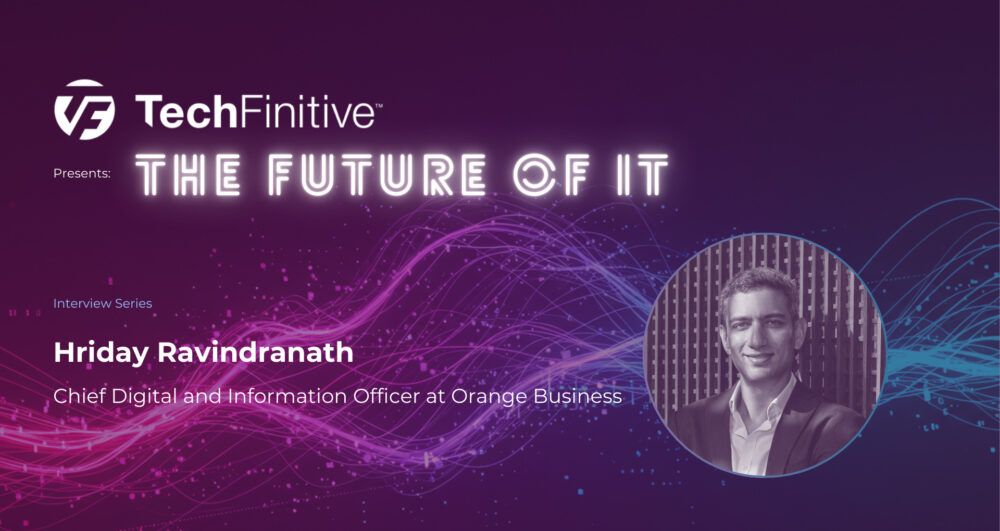
Hriday Ravindranath, Chief Digital and Information Officer at Orange Business: “Geopolitical tensions will increasingly influence the IT supply chain”

Political change is happening fast, and in times like these, it takes a sharp, well-informed mind to see what’s coming next. Fortunately, Hriday Ravindranath, Chief Digital and Information Office at Orange Business, is more than ready. Recognised as a World Economic Forum Young Global Leader, Hriday isn’t just keeping up, he’s thinking ahead.
The perspective Hriday brought to our interview was refreshingly grounded. While he’s confident that AI is “the most transformative technology in the coming decade,” he’s well aware of the regulatory challenges that title brings. As he puts it, “for businesses to realise the technology’s full potential, they must embrace responsible AI practices”.
Hriday adds that “in the next few years, businesses will require AI-ready infrastructures that facilitate the secure control of data”, and must do all of this whilst “navigating geopolitical and regulatory obstacles”. While this seems a daunting task, he remains confident that it’s possible to build systems that can survive what he calls an “ever-evolving threat landscape”.
The abilities of AI stretch well beyond the business world, however. In healthcare, Hriday points out that “in emergencies, every second counts” and thanks to AI, the speed and precision of communication has never been better. He’s also a strong believer in AI’s potential to aid in “drug discovery, speeding up diagnoses and improving clinical note-taking”. When saving time could mean saving lives, Hriday is ready to defend the benefits of AI.
Even with such a clear vision of AI’s future and its transformative potential, it can be hard to see a clear path in today’s complex geopolitical landscape. That’s why we started our interview by asking Hriday about what we can expect in the short-term.
What do you think will be the most significant changes in the IT industry over the next 5-10 years?
The rapid evolution of technology will continue to reshape the IT landscape throughout the next 5-10 years, necessitating adaptability and innovation. One of the most notable trends is the rise of AI. While advancements in large language models and generative AI applications are accelerating, enterprise adoption remains limited. Many organisations are leveraging AI tools to boost productivity, but widespread deployment that fundamentally alters business models is still on the horizon. The long-term impact of AI on the IT sector will be profound.
Geopolitical tensions will also increasingly influence the IT supply chain. Non-EU providers may face challenges in accessing the European market, complicating global operations. Additionally, heightened regulatory scrutiny, especially in Europe, will emerge from these geopolitical dynamics and raise concerns over data access. In the US, a volatile regulatory environment will require companies to navigate global inconsistencies. The organisations that can adapt swiftly to these regulations may gain a competitive edge by building trust with their clients.
Finally, the IT industry will continue to grapple with talent shortages, exacerbated by increased investments in AI. Companies will face difficulties in attracting and retaining skilled professionals, while transformation fatigue may lead to higher turnover rates. In summary, the interplay of technological advancements, geopolitical factors, regulatory changes and human resource challenges will define the IT industry’s trajectory in the coming years.
How do you envision the role of IT professionals evolving in the future?
Given the rapid acceleration in the use of technology by businesses over the last few years, the role of IT professionals is undoubtedly going to undergo a significant change. As leaders in innovation and enablers of digital transformation, our team’s role is not just to provide technical support anymore, but to work closely with the wider organisation to shape positive business outcomes and to become pivotal thought leaders for the organisation.
The role of IT professionals will evolve to transition away from technology-centric thinking, to become a true business partner focused experience and on transforming the entire organisation, aided by the power of technology.
Businesses now must build a culture where IT professionals are no longer seen as a siloed workforce dealing in code and building security, but as a vital part of the business strategy and success. This shift will remain critical as technology increasingly serves as the foundation for modern business operations, driving innovation, streamlining efficiency and securing a lasting competitive edge.
Which emerging technologies do you think will have the biggest impact on IT in the coming decade?
Artificial Intelligence will remain the most transformative technology in the coming decade. And whilst AI is already reshaping industries by enhancing decision-making, driving automation and delivering more personalised experiences, the IT leaders who focus on cutting through the AI hype and delivering measurable value will be the ones who see the greatest success.
However, this transformative potential comes with the responsibility to use AI ethically. Accountability, transparency and data protection must be prioritised, particularly as businesses navigate an evolving regulatory landscape like the EU AI Act.
Building a solid AI governance strategy is crucial to using AI responsibly. A Responsible AI framework – tailored to specific use cases and actively managing risks – ensures alignment with regulations and ethical practices from the design stage onward. In the decade ahead, AI will be a key enabler of innovation, productivity and resilience. But for businesses to realise the technology’s full potential, they must embrace responsible AI practices, ensuring that technology serves both business goals and societal needs.
What role do you foresee for edge computing and IoT in shaping IT infrastructure?
The rise of edge computing is reshaping how businesses process vast volumes of data by enabling faster, localised decision-making, driven fundamentally by the rapid expansion of IoT devices. Together, edge computing and IoT form the perfect pairing to enable real-time data that will shape the future of IT infrastructure. This further amplifies with AI
The need for flexibility, viability and security within organisations is growing rapidly to remain competitive in a rapidly changing world, and edge computing could address these challenges. Additionally, it plays a crucial role in ensuring business continuity; in scenarios where connectivity to the cloud is lost, edge computing allows operations to continue seamlessly.
In the coming years, edge computing will offer a considerable advantage as the number of IoT devices connected to networks continues to rise. Its ability to process sensitive data locally not only mitigates the risks of cyber threats and data breaches but also enables real-time security measures. Moreover, this local processing supports data sovereignty by ensuring that sensitive production data does not need to be sent to public clouds.
As we implement more IoT solutions, we will shift from relying on centralised systems to decentralising security, allowing our systems to recognise and address threats in real-time.
As the number of IoT devices continues to rise, so too will the volume of data they generate. By distributing processing power across several localised nodes, edge computing enables organisations to scale effectively.
This decentralisation also allows for AI at the edge, where pre-trained models can run on edge devices, significantly reducing the amount of data that needs to be processed in the cloud, which can become very expensive quickly. This decentralised strategy ensures companies can manage rapidly increasing data volumes whilst preserving peak performance and reducing latency. Scalability will guarantee that our IT infrastructure remains resilient and flexible.
With the rise of AI and big data, how do you think IT will address challenges related to cybersecurity?
IT leaders are finding it increasingly challenging to strike a balance between cybersecurity, data privacy and regulatory compliance, as a result of the rapid acceleration of AI and big data. Whilst these technologies provide huge opportunities, they also create significant cybersecurity challenges that require a multifaceted approach.
Typical risks associated with AI include bias and discrimination in AI models, data poisoning attacks, model inference attacks and insider threats. In the next few years, businesses will require AI-ready infrastructures that facilitate the secure control of data to preserve confidential information while navigating geopolitical and regulatory obstacles.
As businesses turn to multi-cloud methods to handle the vast data flows needed to effectively use AI technologies, one key challenge is ensuring data sovereignty – the requirement that businesses manage data in accordance with local and global regulations.
To guarantee data sovereignty, secure end-to-end connectivity and secure data hosting must be prioritised by businesses to ensure data flows are protected across borders. Robust cybersecurity measures are essential to data sovereignty plans to minimise the risk of breaches and protect customer trust.
Ensuring transparency around those measures and plans fosters digital trust and encourages the data sharing needed to effectively deploy AI. By addressing the challenges associated with the rise of AI and big data holistically, we can develop resilient systems capable of withstanding an ever-evolving threat landscape.
In what ways do you think IT will transform industries like healthcare, education, or finance?
In emergencies, every second counts. With 5G, healthcare professionals can share real-time data, improving coordination and giving hospitals advance warnings about patients, ultimately saving lives. Faster data transfers also enhance patient care, while AI is also making waves in healthcare by aiding in drug discovery, speeding up diagnoses and improving clinical note-taking.
Education is also embracing AI, with institutions implementing a variety of AI applications, such as chatbots for student inquiries, personalised learning platforms that adapt to individual needs, AI-driven tools for creating digital flashcards, and systems that provide real-time feedback on assignments.
As we’ve seen, some schools are already using AI for interactive learning, while others rely on it for tasks like managing records and scheduling. To fully realise the benefits of AI, educators and IT professionals must collaborate, making teachers learning architects who use AI to enhance education while maintaining their essential roles as guides.
For finance, fast and secure connections are essential for real-time data sharing, a crucial component for risk assessment, fraud detection and overall better decision making and customer experiences. Emphasising secure data handling ensures that sensitive financial information is protected, fostering trust between institutions and their clients.
We’re already seeing the technology being used for administrative tasks, alongside exciting developments in predictive analytics and personalised financial services.
More interviews in the series
- Marc Lueck, CISO in Residence at Zscaler: “The next major shift in IT will centre around simplicity”
- Kevin Marcus, CTO at Versium: “Quantum computing may end up as a random answer generator”
- Sam Peters, Chief Product Officer at ISMS.online: “You may not think that AI is part of your role, but that’s not to say that it can’t and shouldn’t be used”
About The Author

Rowan Campbell
NEXT UP


