Trending Topics

 Trending
How generative AI’s rise may impact your career

Are you worried you’re going to lose your job to AI? If you are, you’re definitely not alone. Following the huge success and adoption of ChatGPT, if you ask Google the question “will I lose my job to AI?”, you’ll get about 1,120,000,000 results.
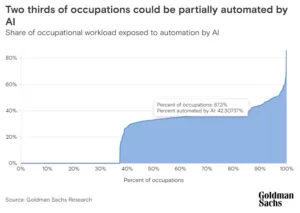
In addition to hundreds of thousands of column inches of think pieces about the topic comes research from global financial institution Goldman Sachs. Its report says that roughly two-thirds of current jobs are likely to be affected by some degree of AI automation, and it also estimates that about 20% of current work tasks could be automated by AI.
ChatGPT itself is more modest, pointing out that: “As an AI language model, I don’t have the ability to take anyone’s job. My purpose is to assist and provide information to the best of my abilities.”
Positive and negative outcomes
That sounds nice and safe –– not to mention diplomatic. But the most likely outcome, as things stand right now, is those generative AI solutions are likely to have both positive and negative outcomes.
For example, while professional services company Accenture thinks that 40% of all working hours could be impacted by generative AI tools, Goldman Sachs’ research has found that generative AI could raise global GDP by 7% over a ten-year period.
On the downside, The World Economic Forum’s (WEF) Future of Jobs Report 2023 says that jobs such as clerical or secretarial roles, including bank tellers and data entry clerks, are likely to decline.
Traders, financial analysts and personal financial advisors could be impacted too, because tasks such as identifying market trends, can be effectively done by AI. And customer service roles are increasingly being replaced by chatbots, as highlighted in our recent Future of Work feature.
Jobs on the rise
Another upshot is that the WEF estimates 97 million new jobs will emerge by 2025 to enable humans and machines to work together. It highlights three new job roles across prompt engineering, remote truck driving and wind turbine technician.
Professor Erik Brynjolfsson, director of the Digital Economy Lab at Stanford University, told the audience at Davos 2023 “I think even going forward we are going to develop a new job, the job of prompt engineering,” adding that “you will all be hearing about it soon”.
The job refers to the process of designing and refining prompts to achieve desired outcomes when using large language models like ChatGPT.
Prompt engineers will be vital because it is their skills that are going to be essential to crafting well-defined prompts which have the precision required to deliver the right kinds of outputs.
Jobs across the AI spectrum are also set to grow, with LinkedIn data finding that the number of posts referring to “generative AI” increased 36-fold in comparison to 2022, and the number of job postings containing the term “GPT” rising by 51% between 2021 and 2022.
According to the WEF’s aforementioned Future of Jobs Report, it is soft and cognitive skills, such as analytical and creative thinking are now the most desirable. The good news is that these are human-led characteristics that AI tools simply can’t compete with. Yet.
About The Author

Kirstie McDermott
NEXT UP