Trending Topics

 Trending
Inside NVIDIA-Powered AI Infrastructure with Hammer

From networking fabrics to GPU-hungry workloads, Hammer explains how it designs and delivers NVIDIA-powered systems that turn AI ambition into production-ready infrastructure

Every organisation wants to exploit AI, but few know what it really takes to make it work. Beneath every flashy demo or high-performing model sits a tangle of networking, GPU servers and storage driven by system design decisions that can accelerate an AI programme – or quietly throttle it. Hammer, working in partnership with NVIDIA, has made a business out of reducing that complexity for VARs, MSPs and data centre operators who know they need AI-ready infrastructure but can’t afford to get the architecture wrong.
For Adam Blackwell, Hammer’s Director of AI and Server Technologies, the starting point is always the same: a customer with an ambition and no clear path to achieving it.
“Every company’s got an AI target on them,” he said, whether that’s a dedicated team, an overstretched IT lead, or simply a board mandate to “use AI somewhere”. Hammer’s job is to turn that impulse into something workable. Through its AI Works programme, the company takes partners from the first problem statement – “I have a problem, I want to fix it with AI” – through to deployment, optimisation and ongoing maintenance of a solution that can survive real-world use.
Turning theory into real-world practice
That process begins not with hardware but with translation. Most customers don’t yet fully understand the profile of the workloads they are trying to run as they behave differently to traditional workloads, and Adam is clear that you can’t simply “jump straight to sizing the environments”. Instead, Hammer starts with the business context: What are they trying to achieve? How many users will rely on the system? What performance behaviour do they expect? Which data do I need to feed it with and where is it? Only once this is fully understood does the team define the environment, specify the software, and then architect the underlying infrastructure.
It sounds simple, but this sequencing is where so many AI projects fall apart. The gulf between a traditional enterprise infrastructure and AI infrastructures is significant, especially in the networking area, and Hammer has spent more than a decade preparing for exactly that shift.
Long before Mellanox became part of NVIDIA, Hammer was the first distributor in EMEA to bring its networking technology to market – and that early start matters. AI networking is not an incremental upgrade to the switching gear already running in the data centre. It requires specialised, tightly tuned fabrics designed to move vast volumes of data at extraordinary speed. Hammer’s teams, including NVIDIA-certified engineers, product specialists and sales experts, focus exclusively on this kind of infrastructure, giving the company an institutional memory of AI networking that most partners simply don’t have yet.
Blackwell puts it more bluntly. You can buy the latest GPUs, but “you don’t go and buy a Ferrari and then just drive it on a single-track village road”. Without the right network, the most powerful servers in the world will underperform.
Networking: AI’s secret superpower
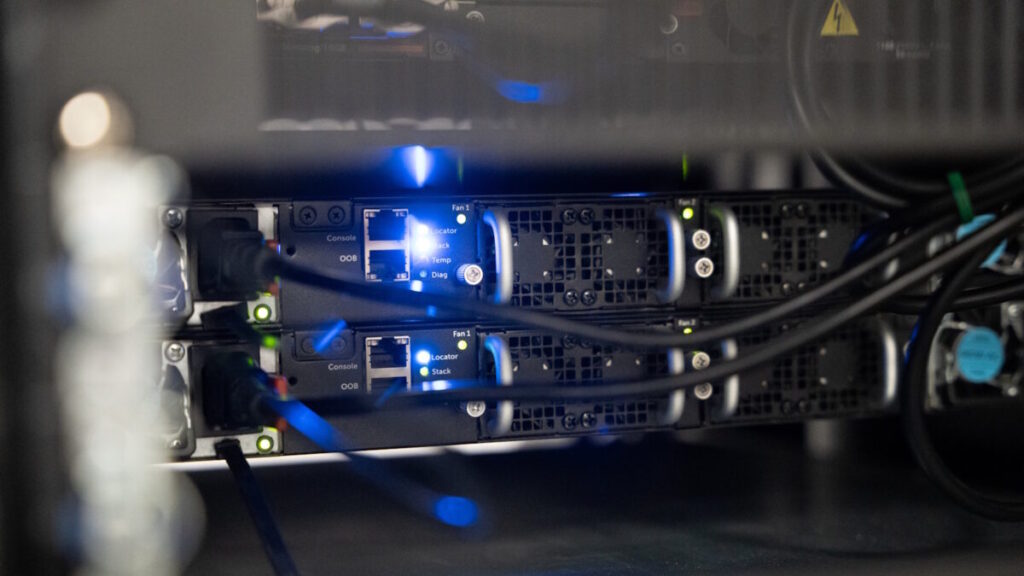
Despite this, networking is often the least appreciated part of an AI build. Hammer, by contrast, begins every engagement by understanding servers, storage and networking together: where the kit will live, how data will move between sites, how the fabrics will be linked, and what the customer’s operational realities are on day one and on day 1,000.
It’s important to note here that Hammer builds AI solutions using NVIDIA Reference Architectures. This gives partners the reassurance of predictable performance, quicker rollouts and lower risk, due to NVIDIA’s proven expertise at building scalable AI and HPC infrastructure.
It also means partners enjoy the full benefit of NVIDIA Spectrum-X networking, which is designed to deliver ultra-low-latency, lossless performance for demanding AI training and inference workloads. Likewise Quantum X800 InfiniBand, a next-generation network platform that delivers 800Gbits/sec of bandwidth.
The complexity of these architectures is precisely why Hammer positions itself as a consultative distributor rather than a box-shifter. Adam recalls a recent exchange with a pre-sales engineer who was asked why he didn’t give a customer apples when they asked for apples. His answer: because he wants to give them apple pie at a more cost-effective price than just apples! Understanding the problem they want to solve and then providing future proof options.
A server or switch on its own solves nothing; Hammer’s value lies in the design, pre-sales consultation, integration expertise, and delivery experience that turns those components into a cohesive, scalable, production-ready AI estate.
Delivering AI at scale – and over the long term
Scalability is a recurring theme. With GPUs advancing at a pace that outstrips every other part of the stack, partners are rightly worried about building something that becomes obsolete too quickly. Hammer responds by championing disruptive technologies that extend asset lifespans and make scaling easier, such as the ability to pool and share GPUs across infrastructure and to harvest RAM to improve overall performance.
For Adam, the long view matters as much as the short one: “You need to understand not just what the customer is trying to achieve today and tomorrow, but in five, ten, 15 years, and how they want to scale that.”
Taking this long view also means addressing costs honestly, especially the hidden ones. Many organisations start their AI journey in the public cloud because it offers speed, convenience, and instant access to GPUs. But as he notes, “that’s when the costs start, and they do spiral, and it’s very hard to get out of them”.
Costs aren’t the only casualty of this approach. Data sovereignty regulations could rule out public cloud completely or drive data placement and other compliant approaches. We must also consider the constant threat posed by cyberattacks as the data used in these environments tends to be highly sensitive. Little surprise, then, that we’re seeing an increasing clamour for data re-patriation.
This is why Hammer rarely advocates a pure-cloud strategy, preferring a hybrid approach that gives customers the agility of the cloud when needed and the cost control and performance of on-prem systems when workloads become heavy or long-running. On-prem also provides a layer of resilience and redundancy that becomes essential as AI moves into business-critical roles.
Hammer’s broader capabilities enable it to support these hybrid and scalable strategies in ways few others can. The company’s depth across servers, storage and networking means it can design end-to-end systems rather than leaving customers to stitch together mismatched components.
Take Hammer’s AI Voyager programme. This gives partners reference architectures, lab access and hands-on training to build confidence in what is often unfamiliar terrain.
The company’s long and close partnership with NVIDIA grants it early visibility into product roadmaps and direct access to the teams shaping next-generation AI compute and networking. And because Hammer designs multi-vendor solutions, organisations can spread risk and avoid single-vendor bottlenecks that increasingly shape the high-end AI hardware market.

The Hammer promise
All of this is underpinned by a brand with deep roots in the UK channel. Hammer’s recent decision to revert to its original name – it was known as Exertis Enterprise from 2018 to October 2025 – has gone down well internally and externally.
Adam laughs that he spent years explaining that the company was still “the same Hammer people offering the same Hammer ethos”, only under a different banner. Now that the brand is back, he says you can feel the energy on the sales floor. The industry, too, remembers what Hammer stood for: specialist knowledge, deep vendor relationships, and a willingness to get hands-on with the most complex parts of a build.
That heritage is likely to matter even more as AI adoption accelerates. Spectrum-X networking and NVIDIA’s broader AI stack are rapidly becoming the backbone of modern data-driven organisations, but only if they’re designed and deployed correctly. Hammer’s argument is that the UK needs partners who don’t just sell technology but can explain it, translate it, and assemble it into architectures that deliver value the first time rather than the fourth.
In a market crowded with AI rhetoric, the company wants to be the one showing people what actually powers AI – and how to build it without stumbling into the bottlenecks that have already tripped up early adopters.
About The Author

Carly Page
NEXT UP


