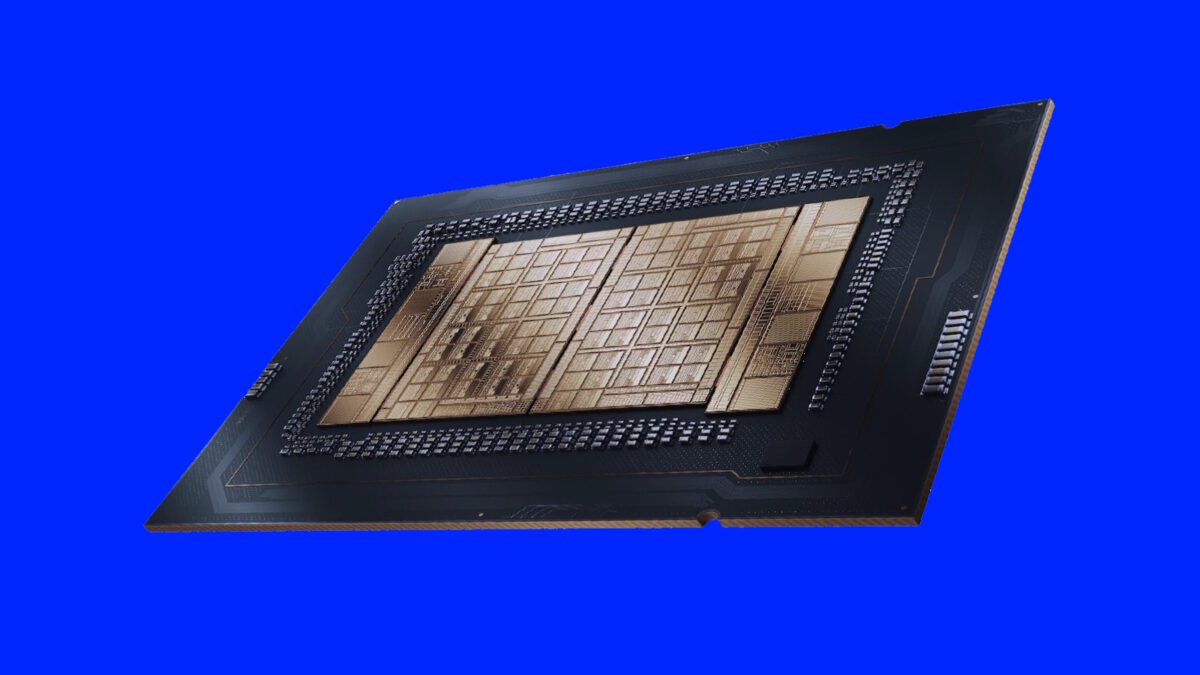
Intel has announced a new family of Xeon 600 Processors for Workstation designed for heavy-duty compute tasks. Tasks such as AI development, photo-realistic visualization, complex CAD modelling and sophisticated 3D animation.
“From a platform perspective, this is the AI developer’s dream,” said Jonathan Patton, Intel Client Product Marketing. “This is a platform that fills both the CPU-based inferencing need and a multi-GPU connectivity need.”
The Xeon 600 family includes 11 different members, ranging from 12 to to 86 cores, each of which features Intel AVX-512 and AMX extensions. The latter means support for Integer8, Bfloat16 and (the new entry) FP16. With a maximum of memory of 4TB, up to 128 PCIe 5.0 lanes and CXL 2.0 support it marks a significant upgrade for AI developers.
There’s also a bump in RAM bandwidth due to support for Multiplexed Rank DIMM (MRDIMM), which places two ranks of RAM onto a single module. That’s particularly useful for memory-bound workloads, with data rates up to 8,000MT/sec.
The Xeon 600 Processors are based on Intel’s Granite Rapids technology, previously limited to servers, and use the Intel 3 process rather than the newer, more efficient Intel 1.8 process.
They will go on sale, as standalone chips and in systems, from late March.
Pricing and specs for the Xeon 600 Processors for Workstation family
Full breakdown of the Xeon 600 Processors for Workstation family (image: Intel)
There are 11 SKUs at launch. The top six, as shown in the table above with the suffix “X”, are unlocked. During a briefing, Intel Product Marketing Engineer Zachary Kranich said says this will give users options.
“We found a lot of value in this from the Xeon space, primarily targeting system integrators, giving them the options to tune and tweak and get the best performance that they need for their workload, their use conditions, and all of that good stuff.”
He added: “[It] gives the user the ability to say, hey, I care more about performance than I care about necessarily stability or longevity,” he said. “Let me go crank it up as much as possible to get the most out of this for, you know, as long as I can.”
Others will lean to stability who “need this system to be rock solid for five years”.
Intel is also working with Ocbase to add support for the Xeon 600 Processor family to the OCCT app. “They’ve added a tonne of capabilities with us to get dynamic overclocking controls in that application,” said Kranich.
“Windows support, obviously, but Linux support is going to be included as well here, which is awesome. You get all the platform telemetry, stability testing, configured benchmarking, all integrated within that tool.” Intel hopes support will be there from launch, but there might be a slight delay.
Only five of the 11 SKUs will be boxed for retail sales, complete with package carriers to attach to heatsinks:
18-core Xeon 654
24-core Xeon 658X
32-core Xeon 676X
48-core Xeon 678X
64-core Xeon 696X
So, how much faster will the new Intel Xeon 600 Processors be?
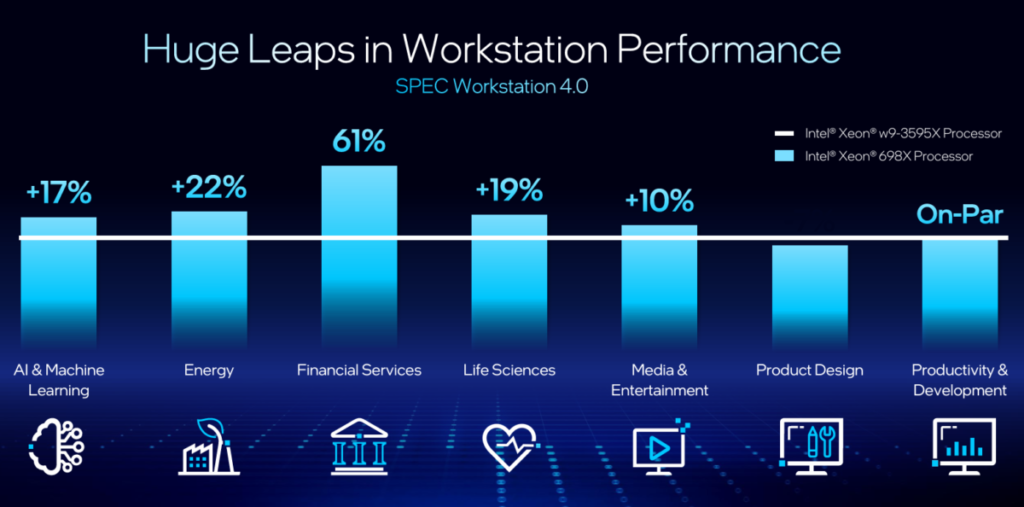
If we use Cinebench 2026 as our guide, and believe Intel’s results, then we can expect up to 9% higher performance in single-threaded tasks and a whopping 61% higher performance in multi-threaded tasks. As Intel puts it, “huge leaps in workstation performance”. In fact, it has a slide that says so:
There are two things to note about this slide. First that it’s comparing performance of the 86-core Xeon 698X processor against the 60-core Xeon w9-3595X. The second that there’s no mention anywhere of how the new chips fare against AMD’s Threadripper family.
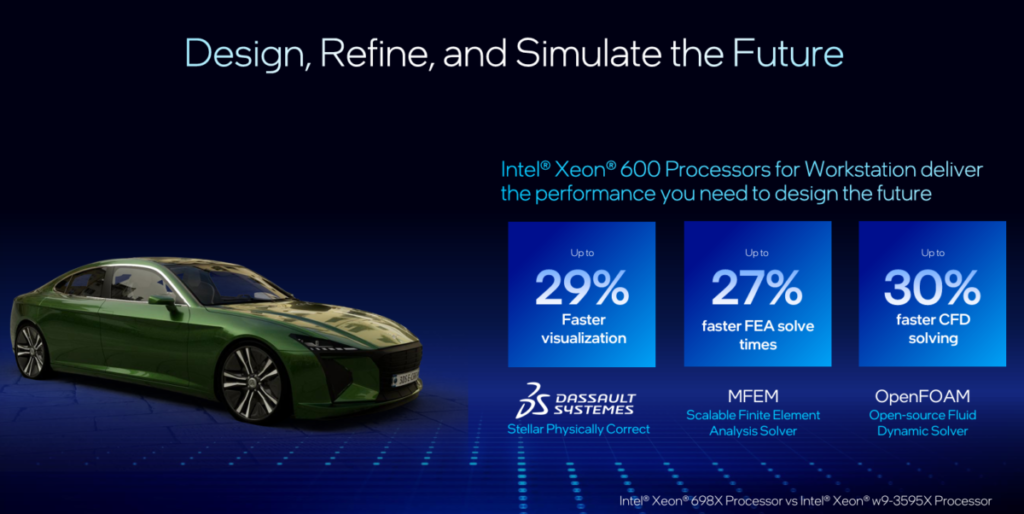
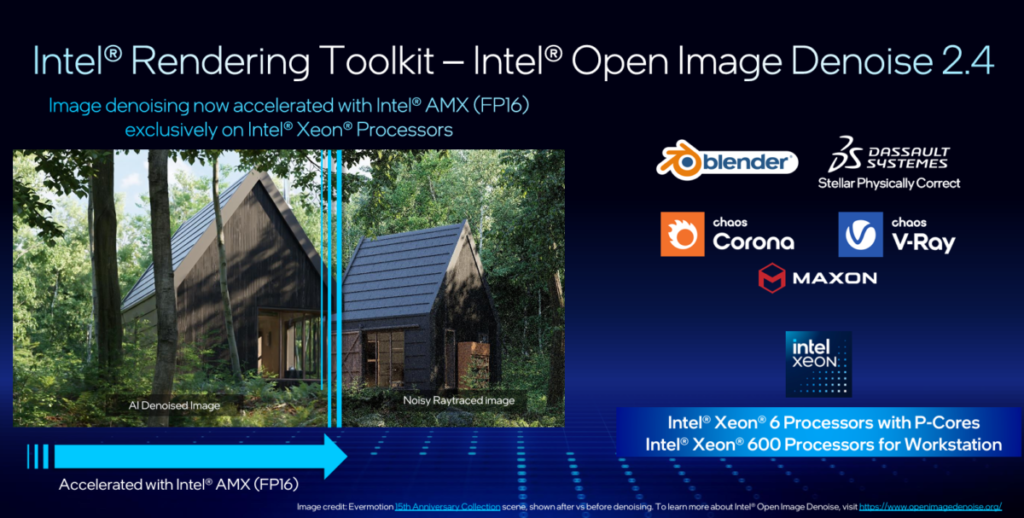
With that caveat firmly in place, there are good signs if you dig into the details via four further slides, which I’ll add as a gallery.
Kranich also casually dropped in that Intel has been working with Asus to overclock the Xeon 698X processor – and claims that at launch the pair will claim ten world records.
“These results demonstrate what’s possible when processor architecture and motherboard engineering are co-optimized from day one,” Jonson Lee, Head of Research & Dev at Asus is quoted as saying on a slide.
“Our R&D team worked closely with Intel to fully unleash the overclocking headroom of Xeon 698X, setting new global benchmarks in extreme performance.”
Should you choose the Xeon 600 Processor for Workstation?
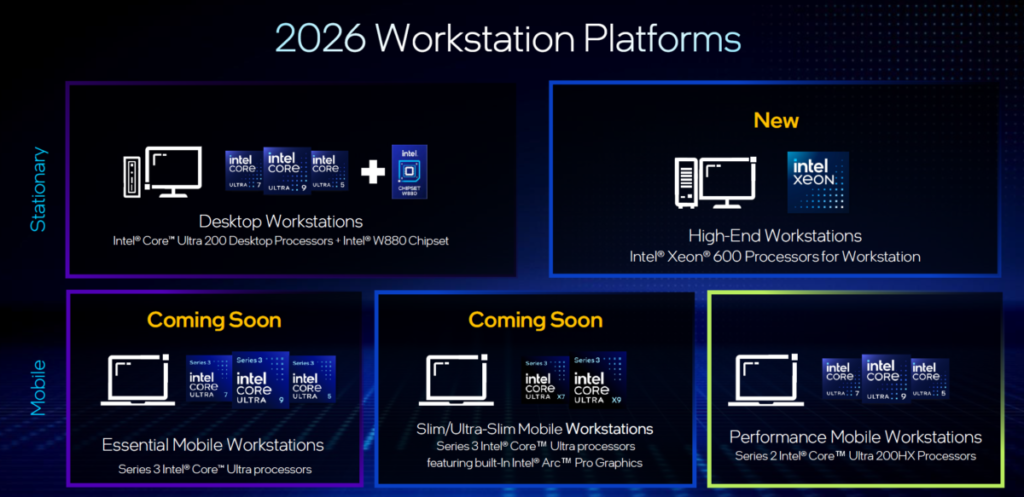
You may be wondering where the Xeon 600 family sits in with the rest of Intel’s chips. And also if there’s a hint of what’s to come for mobile workstations. Intel provides the answer via this handy slide:
How the Xeon 600 family fits in (image: Intel)
The message here being that there’s more to come this year for slimline and affordable mobile workstations, but if you want power then you’re currently limited (Intel wouldn’t use that word) to Core Ultra 200HK processors. Or, ahem, AMD.
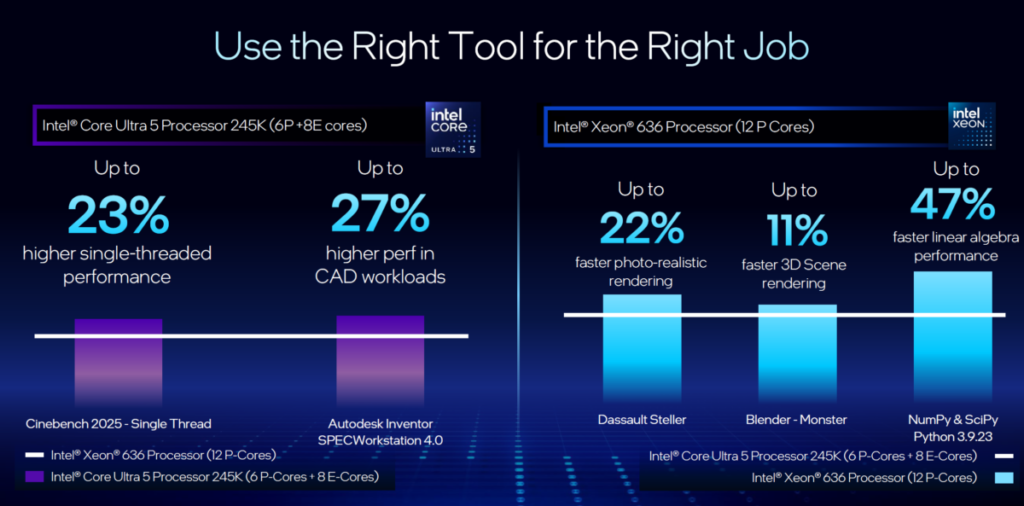
Before you buy a high-end desktop PC, Intel is also keen to say that you should “use the right tool for the right job”.
Core Ultra 200K vs Xeon 600 Processor (image: Intel)
This is a telling slide, comparing the Core Ultra 5 245K with 6 P-cores and 8 E-cores to the low-end Xeon 636 with 12 P-cores. The comparable single-threaded performance, where the 245K wins, is particularly notable, but it’s clear that the Xeon is a better choice for professional workloads (other than CAD).
Choose carefully, in other words.
Intel listed Dell, HP, Lenovo, Supermicro, Boxx and Puget Systems as hardware partners for launch in late March 2026, so keep an eye on those sites for availability.
About The Author
Tim Danton
Tim has worked in IT publishing since the days when all PCs were beige, and is editor-in-chief of the UK's PC Pro magazine. He has been writing about hardware for TechFinitive since 2023.
To provide the best experiences, we and our partners use technologies like cookies to store and/or access device information. Consenting to these technologies will allow us and our partners to process personal data such as browsing behavior or unique IDs on this site and show (non-) personalized ads. Not consenting or withdrawing consent, may adversely affect certain features and functions.
Click below to consent to the above or make granular choices. Your choices will be applied to this site only. You can change your settings at any time, including withdrawing your consent, by using the toggles on the Cookie Policy, or by clicking on the manage consent button at the bottom of the screen.
Functional
Always active
The technical storage or access is strictly necessary for the legitimate purpose of enabling the use of a specific service explicitly requested by the subscriber or user, or for the sole purpose of carrying out the transmission of a communication over an electronic communications network.
Preferences
The technical storage or access is necessary for the legitimate purpose of storing preferences that are not requested by the subscriber or user.
Statistics
The technical storage or access that is used exclusively for statistical purposes.The technical storage or access that is used exclusively for anonymous statistical purposes. Without a subpoena, voluntary compliance on the part of your Internet Service Provider, or additional records from a third party, information stored or retrieved for this purpose alone cannot usually be used to identify you.
Marketing
The technical storage or access is required to create user profiles to send advertising, or to track the user on a website or across several websites for similar marketing purposes.
To provide the best experiences, we use technologies like cookies to store and/or access device information. Consenting to these technologies will allow us to process data such as browsing behaviour or unique IDs on this site. Not consenting or withdrawing consent, may adversely affect certain features and functions.
Functional
Always active
The technical storage or access is strictly necessary for the legitimate purpose of enabling the use of a specific service explicitly requested by the subscriber or user, or for the sole purpose of carrying out the transmission of a communication over an electronic communications network.
Preferences
The technical storage or access is necessary for the legitimate purpose of storing preferences that are not requested by the subscriber or user.
Statistics
The technical storage or access that is used exclusively for statistical purposes.The technical storage or access that is used exclusively for anonymous statistical purposes. Without a subpoena, voluntary compliance on the part of your Internet Service Provider, or additional records from a third party, information stored or retrieved for this purpose alone cannot usually be used to identify you.
Marketing
The technical storage or access is required to create user profiles to send advertising, or to track the user on a website or across several websites for similar marketing purposes.

 Trending