Trending Topics

 Trending
Real vs fake receipts: How your employees are using the AI you pay for to defraud you

The AI tools your company pays for is being turned against you. New data reveals that a growing number of employees are using employer-funded AI subscriptions to fabricate expense receipts, and the scale of the problem is accelerating faster than most finance teams realise.
In March 2025, AI-generated receipts accounted for exactly 0% of flagged fraudulent expense claims on AppZen’s platform. By mid-May 2026, just 14 months later, that figure had jumped to 71%. In that period, AppZen caught 1,471 AI-generated fakes submitted by 745 employees across 174 companies, totalling $148,143 in fabricated reimbursement claims.
A separate Emburse survey of 2,000 business professionals across the US and UK found that 34% admitted to using AI to generate a fake receipt for a business expense. In the US, that figure climbed to 40%.
The most striking detail? Of those who admitted to creating fraudulent receipts, 36% used AI tools funded by their own employer to do it.
In other words: the same AI budget meant to drive productivity is quietly subsidising fraud.
It has never been this easy to fake receipts
Receipt fraud isn’t new: people have looked for ways to cheat the system ever since we invented the wheel. It’s just that things are now much easier.
Creating a convincing fake once required photo-editing skills or specialist software. Today, it takes less than a minute to create a convincing, branded, itemised, tax-formatted receipt, all using a basic text prompt to a generative AI model.
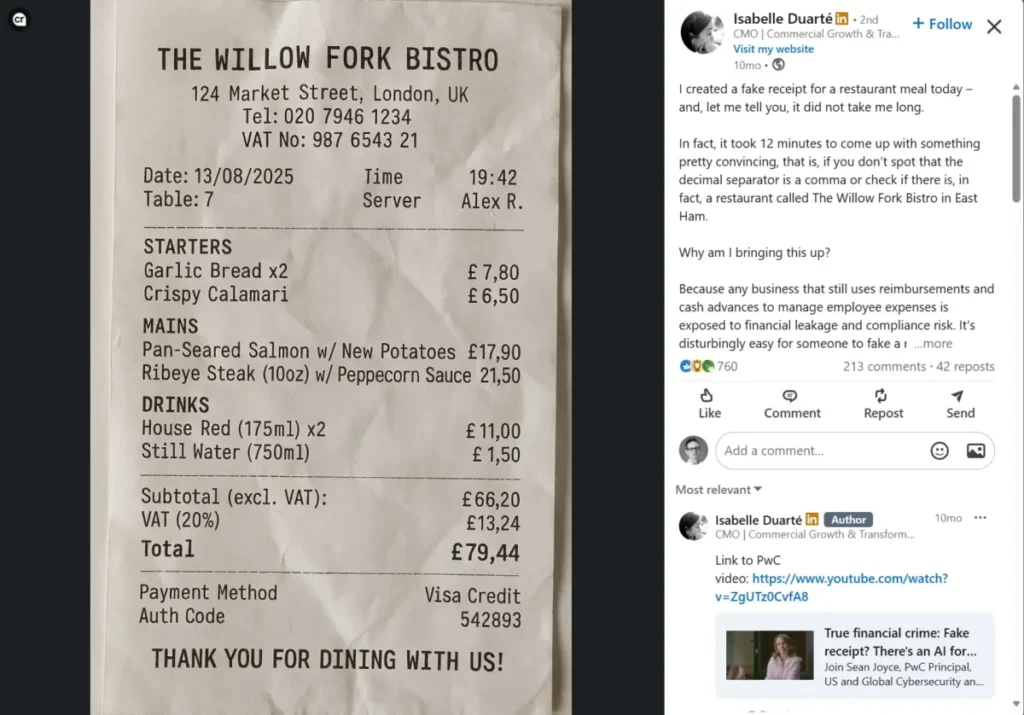
Soldo’s Chief Marketing Officer, Isabelle Duarté, tried it herself out of curiosity. She was able to produce something “convincing enough to slip through the net” in a matter of minutes. As Mason Wilder, Research Director at the Association of Certified Fraud Examiners, put it: “There is zero barrier for entry for people to do this. You don’t need any kind of technological skills or aptitude like you maybe would have needed five years ago using Photoshop.”
The fraud profile has also shifted.
Rather than large, attention-grabbing claims, AI-generated fakes are typically small, with a median value of around $32, according to James Broughel, a Regulatory Economist and Senior Research Fellow at the Mercatus Center at George Mason University. This low value is deliberately calibrated to stay below the automatic approval thresholds that no human ever reviews. Low value, high volume, and nearly invisible.
Why traditional controls are failing
Finance teams are leaner than ever, and expense review sits at the bottom of their priority list. Which makes sense: they were not built for this threat.
Platforms that rely on OCR and visual inspection are now structurally blind to AI-generated fakes, because the images are simply too realistic for the human eye to distinguish consistently. SAP Concur’s Chris Juneau put it bluntly: “These receipts have become so good, we tell our customers, ‘do not trust your eyes’.”
Is AI receipt fraud really a threat to your business?
This on-demand webinar explores the growing threat of AI-generated receipt fraud and what finance leaders can do to protect their organisations from increasingly sophisticated expense fraud.
Traditional expense controls were designed for a world where fraudulent documentation required effort, skill and deliberate intent. AI has dissolved all three prerequisites. The result is that policies built around receipt submissions, per-diems, reimbursement caps and spot audits offer little resistance to a threat that can generate a perfect-looking receipt in seconds.
As we explored in our coverage of AI governance and enterprise architecture, the gap between AI adoption and the governance frameworks meant to contain it is widening fast. Expense fraud is one of the most immediate places where that gap costs real money.
The AI receipt fraud fix is structural, not cosmetic
The answer is not to ask finance teams to look harder. It is to redesign the process so that suspicious receipts are less likely to exist in the first place.
Matching submitted receipts against actual card transaction data, date, time, merchant name and total, immediately narrows the window for fraud. Prepaid cards with real-time controls go further: if every transaction is already captured at the point of purchase, the receipt becomes secondary evidence rather than the primary source of truth.
Global tissue paper manufacturer Sofidel took this to its logical conclusion. With 7,000 employees across 17 countries, the company eliminated reimbursements entirely by issuing prepaid cards through Soldo, removing the mechanism by which fake receipts could ever enter the process.
The security parallel is instructive.
As covered in our analysis of ThreatAware’s approach to cyber asset management, the principle is the same: you can’t protect what you cannot see. Reactive controls that check for problems after money has moved are losing ground to proactive visibility that prevents the problem from arising at all.
A governance question, not just a finance one
There is also a broader AI governance dimension here. Emburse’s research found that 61% of employees are using employer-funded AI tools outside of work activities. Some are applying for other jobs with them. Others are using company token allocations for personal projects. The expense fraud angle is the most financially quantifiable symptom, but the underlying issue is that enterprise AI spend, in many organisations, has almost no visibility layer attached to it.
Finance and IT leaders need to treat AI subscriptions the same way they treat any other spend category: with policy, visibility and accountability. Until they do, the AI budget will remain, for some employees, an open invitation.
About The Author