Trending Topics

 Trending
IoT and cloud are coming for your poop water

Wastewater treatment is something humans have been giving a decent amount of thought for a long while.
A quick read on Wikipedia and you’ll learn of systems built going back to Mesopotamia dating 4,000 BCE. We’ve figured out how to handle waste while in space. Bill Gates famously drank “poop water”, as shown below. The list goes on.
For all that time spent on a problem so central to our existence, we still have a way to go. A lot of the systems we use are old, expensive and difficult to replace, with so many layers of construction on top that any attempt at innovation is stifled by sheer cost and logistics.
In recent years, climate change has only heightened the cost of inadequate waste treatment infrastructures. The result can be seen in declining water quality, contamination of soils and river systems, and increased pressure on what is arguably our most valuable resource. Not even the famous Eton School is safe, having recently shut down due to Thames Water systems being unable to cope with flooding in the area.
Can green tech turn the proverbial tide on wastewater treatment? Demizine Technology, the startup behind WaterPlantir, believes so.
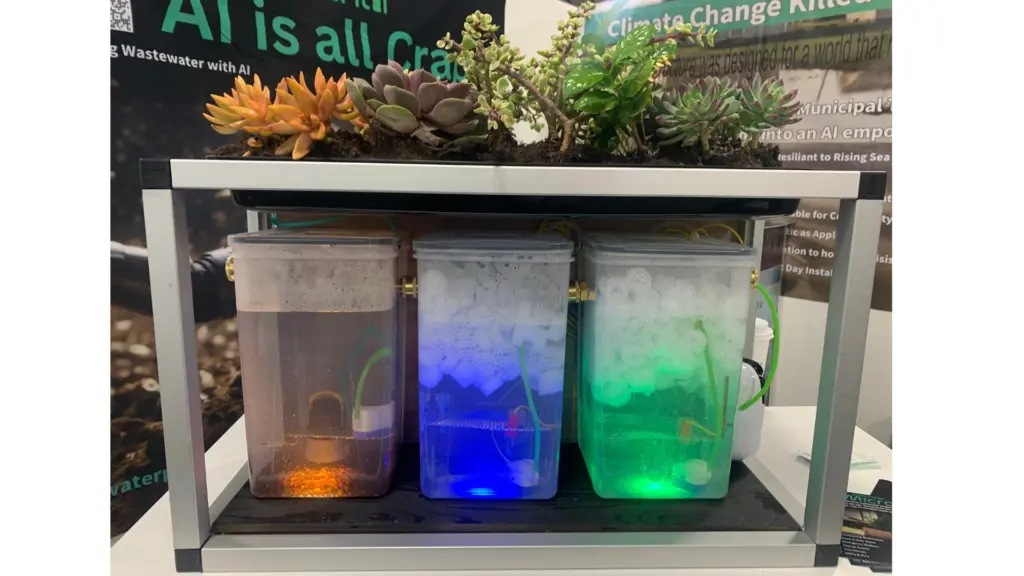
The Canadian company has built a standalone water treatment system that is simple enough to be installed in one day, takes up 99% less space than a traditional septic tank and can be deployed, at scale, both indoors and outdoors.
Sounds interesting? We thought so too, and stopped by its booth at CES 2024 to interview Demizine’s President, Cierra Moffat, who talked us through how IoT sensors and the cloud are part of the solution. Interview below, edited for clarity.
Related reading: Microalgae might help smart cities become greener
Could you start by introducing yourself and the company, please?
My name is Cierra and I’m one of the founders of WaterPlantir Systems. We apply IoT to wastewater treatment systems for black and grey water. [Black water mainly refers to the “poop water” from our headline, while grey water might come from sinks, washing machines, bathtubs and showers.]
How do you do that? What’s special about your product?
By using IoT you can optimise the treatment and you can also detect failures. One of the biggest struggles with septic is climate change, due to flooding, excessive rainwater or drought.
Septic is failing everywhere, and below-ground septic is starting to become restricted. Our system is above-ground and uses sensors to alert users before failure happens.
Is it mostly for small residential use or commercial use as well?
Our systems are modular, so we can scale them depending on the use case. A big use case for us right now is tiny homes and micro living, but because you can stack our systems it means there are plenty of residential or commercial applications.
How long has WaterPlantir been in business?
This is our launch here at CES 2024. We did a soft launch at the Innovative Housing Showcase, last June in Washington, but this is our main launch event.
What are your expectations for CES and the year ahead?
Well, the sky’s the limit! There are so many different applications for our systems. From a B2B perspective, we might work with tiny home manufacturers; from a B2C one, we might work with anyone who has a building in need of septic, be it a vacation home, an office space or just a homeowner who doesn’t want to dig into the ground to have a septic tank installed. We’ve also identified that Canadian First Nations communities are experiencing failings with their septics, so we want to help there. Lots of avenues for us to grow this year.
Your advertising reads “AI is all crap” – what’s that about?
It’s all about drawing you into our booth… and it worked, because you’re here!
In all seriousness, though, the way septic works depends on capacity, starting with how many gallons are coming into the system, and then also, how the microbe colonies stay alive. WaterPlantir uses different sensors which read oxygen levels and measure the temperature in the microbe colony. It then tunes the wastewater treatment accordingly.
Meanwhile, all the data collected by our sensors is uploaded into the cloud and made available in an app that serves both the front-end user, such as a homeowner, but also the back end for regulatory purposes, such as for maintenance workers or auditors.
Related reading: Five simple steps to make your business IT more sustainable
About The Author

Ricardo Oliveira
NEXT UP