Trending Topics

 Trending
What do the lights on the Philips Hue Bridge mean?

Table Of Contents−
- Lights on Philips Hue Bridge
- Advanced troubleshooting for Bridge LEDs
- Flashing vs. solid vs. off indicators
- Hue Bridge Generations – white vs. blue LEDs
- Network and Internet lights – security implications
- Placement tips for best performance
- Managing multiple Hue Bridges
- Accessibility considerations
- More explainers
If you own any Philips Hue products, you’ll most likely also have one of their Bridge devices. These connect their range of smart bulbs to your home or office network, making it simple for you to control them through the app.
The Philips Hue Bridge has 4 glowing blue lights on top, with some symbols that allude to their functions – but what do they actually mean? And, more importantly, what does it mean if one of them doesn’t light up?
There are actually two generations of Philips Hue Bridge, but they have the same light setup.
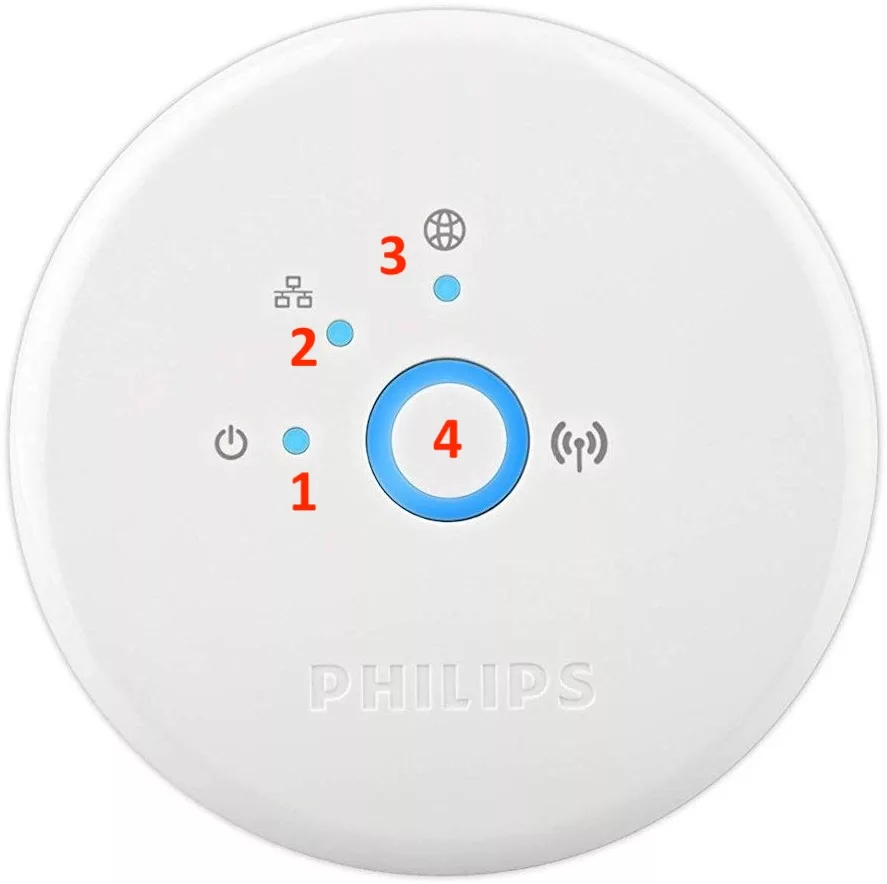
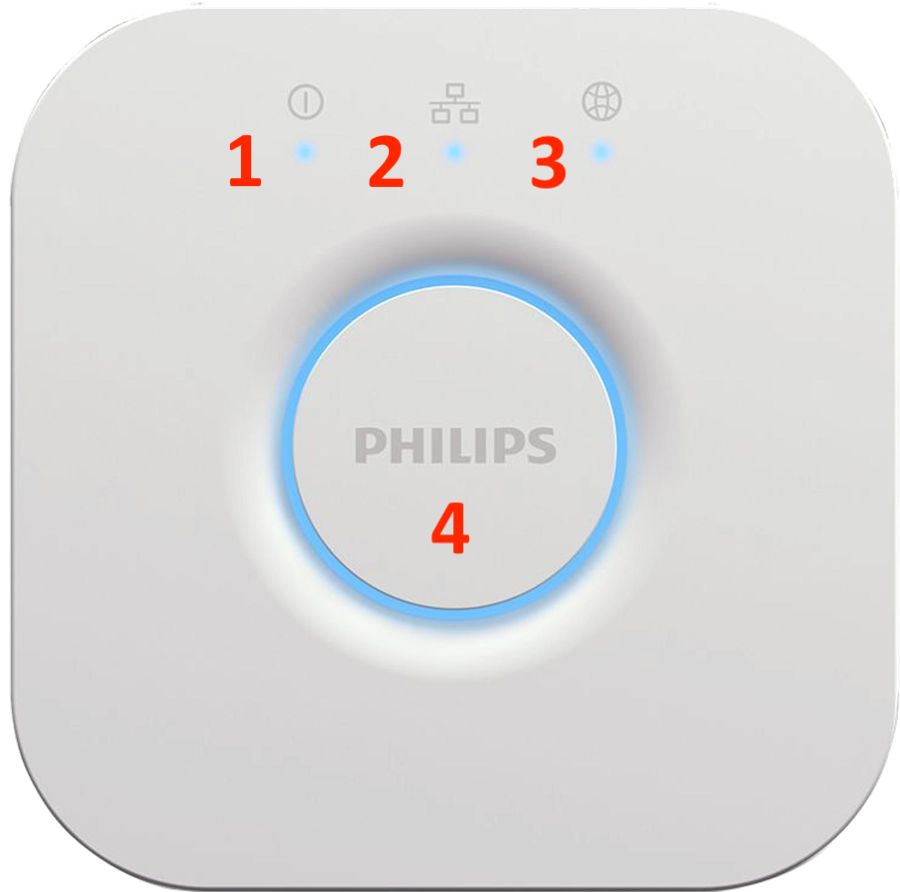
Lights on Philips Hue Bridge
- Power indicator: The mains adapter is connected and the Bridge is powered on.
- Network indicator: The Hue Bridge is successfully connected to your router. If this is not on then you will not be able to communicate with your bulbs.
- Hue Portal indicator. The Hue Bridge is successfully connected to the internet. If this is not on, your lights will still work but you won’t be able to control them through the app.
- Zigbee indicator: Zigbee communication* is up and running.
*Zigbee is a protocol used by various IoT devices to allow them to communicate with each other. Philips Hue supports this protocol, so that the centre button can be used to sync with other Zigbee-compatible networks.
Advanced troubleshooting for Bridge LEDs
- Power LED (far left): If this light is off or blinking, the Bridge isn’t receiving stable power. Check that the official power adapter is firmly connected (and try a different outlet). A blinking power LED often means a faulty adapter; replacing the adapter usually fixes it. If the light never turns on, the Bridge may be defective.
- Network LED (middle): A solid middle light means the Bridge is linked to your router. If it’s flashing or off, the Bridge isn’t getting a proper LAN connection. Make sure the ethernet cable is securely plugged into a primary router port (avoid hubs or switches), and try a different cable or router port. In apartment or office networks, you may need to use your own router or configure a static IP on the Bridge (some users have restored connectivity by assigning a fixed IP address). Rebooting your router and Bridge can also clear DHCP glitches.
- Internet LED (far right): This shows Hue cloud connectivity. If it blinks or stays off after the network light is steady, the Bridge isn’t reaching the internet. First, ensure the Bridge’s firmware is up-to-date – Philips notes the third LED won’t light if the software is outdated, so updating via the Hue app is required. Otherwise, check your internet connection and router (firewall or DNS issues can block the Bridge). Power‑cycle the router and Bridge, or try plugging into a different router or network. If the Bridge still can’t access the cloud, local control will work, but remote Hue services won’t.
- Sync (link) button: The circular button on top isn’t an indicator, but pressing it triggers pairing mode. A slow pulsing around the button means the Bridge is sending a Zigbee network signal. If pairing new lights fails, ensure you press this button when prompted in the app; if it doesn’t pulse, reboot the Bridge and app.
Flashing vs. solid vs. off indicators
- Solid On: A steady LED means that part of the Bridge has established its connection (power on, LAN connected, or internet linked). For example, a solid blue (or white on newer units) LAN light means the Bridge has a good Ethernet link and IP address. No action is needed when lights are solid; it indicates normal operation.
- Flashing: A blinking light usually means the Bridge is attempting to connect. A flashing network LED indicates it’s trying to get on the LAN (perhaps negotiating DHCP). A flashing internet LED means it’s attempting to reach Hue’s servers. If lights stay blinking for long periods, troubleshoot the corresponding connection (power cycle devices, try alternate cables/ports). For instance, if the internet light blinks continuously, checking router settings or performing a manual IP entry (as some users have done) can help stabilise the connection.
- Off: If an LED is off when it normally should be on, it points to a problem. Power off means no juice; network off means no LAN; internet off means no cloud. Philips advises that if the internet LED never lights, first update the Bridge’s firmware. If after updates the light is still off, confirm that the Bridge is plugged into the network and that your internet connection is live.
Hue Bridge Generations – white vs. blue LEDs
Philips has released two generations of the Hue Bridge. The original Bridge (v1, from 2012) is round and features blue glowing indicator rings around each LED. The newer Bridge (v2, 2016+) is a square unit with a white-glowing Hue logo and white LEDs. Functionally the lights mean the same things on both models, but the colour and design differ: if you see blue LEDs, it’s the older round Bridge; white LEDs indicate the modern square Bridge. Note that Bridge v1 is no longer supported (no updates or cloud access), so a v2 is recommended for full functionality.
Network and Internet lights – security implications
The network (middle) and internet (right) LEDs tell you when the Bridge is online. A lit Internet LED means the Bridge is connected to Philips’ cloud services, allowing remote access and voice-control via Alexa/Google. This also means your Bridge is accessible (through the Philips cloud) over the internet. For security, keep the Bridge firmware updated (Philips strongly recommends always installing the latest software) and use a strong Hue account password. If you ever suspect unauthorised access, you can disable “Home” members in the Hue app or reset the Bridge. If you prefer to use Hue entirely offline, you can block the Bridge from reaching the internet at the router level – your lights will then only work on the local network (the network LED can stay on while the internet LED is off). Always follow Philips’ advice to update via the official Hue apps to get security patches.
Placement tips for best performance
- Centralise for Zigbee: The Hue Bridge’s Zigbee range is about 25 meters (≈80 feet) indoors. In a typical home this covers most rooms. Place the Bridge centrally or at least on the same floor as the majority of your lights. Each Hue light you add becomes a repeater, extending the Zigbee mesh, so start with a few lights on opposite ends of the house to boost coverage.
- Avoid obstructions: Don’t tuck the Bridge under a shelf, behind metal, or near large appliances (which can interfere with Zigbee or Ethernet). Higher is usually better than floor level. Also keep it at least a few feet away from routers or microwaves to minimise 2.4 GHz interference.
- Ethernet considerations: The Bridge must be wired to your router. Use the provided cable and plug it directly into a primary LAN port (not through another switch or extender) for the most reliable connection. If your router is far from your intended Bridge location, consider using a high-quality, long Ethernet cable. The Hue Bridge’s settings are stored on the device, so you can move it to a new router later without re-adding all the lights.
Managing multiple Hue Bridges
If you have a very large home or more than 50 lights, you can use multiple Bridges. Philips allows you to set up a second (or even more) Bridge in the Hue app. For example, you might put one Bridge upstairs and another downstairs. Each Bridge is independent – its LEDs only indicate that Bridge’s status. In practice, the app will show you each Bridge separately (you can switch between them in settings). You should assign a subset of lights to each Bridge (for instance, all lights on one floor to one Bridge, and the rest to another). Indicator lights behave the same on each Bridge (power/network/internet meaning), so you can troubleshoot them independently. Just remember: the Hue app can manage up to 10 Bridges, but only 50 lights per Bridge, so design your setup and indicator expectations accordingly.
Accessibility considerations
Because the Hue Bridge itself is a hands-on device, visually impaired users will rely on other means to control the lights. Fortunately, Philips Hue integrates with major voice assistants: once set up, you can say commands like “Alexa, turn on the living room lights,” without needing to see the Bridge LEDs. The Hue mobile app also works with screen-reader software (VoiceOver on iOS or TalkBack on Android) so you can navigate lights and scenes by touch. The Bridge’s own LEDs are purely visual status indicators, so a blind user would have a sighted person handle setup and troubleshooting. After that, all daily control can be done via voice, smartphone, or accessible Hue accessories (like the Hue Dimmer Switch, which is tactile). In short, rely on voice control and app features for accessibility – the Bridge’s lights simply sit in the background.
More explainers
- What will 6G mean for business?
- Why is my Tiscali email not working anymore?
- Where is Cortana in Windows 11?
- Why can’t I download photos from my Android phone to my PC?
This article was updated on the 6th of June with additional info.
About The Author

David Artiss
NEXT UP


