There are times when you’d rather not reveal your mobile phone number when making a call – and not necessarily for nefarious reasons either. In the middle of this Coronavirus crisis, for instance, you might want to make a business call from your personal mobile phone but not give the customer/client your mobile number. Here, then, is how to make a private call on a Samsung smartphone.
How to make a private call on a Samsung smartphone
This method works on the Samsung Galaxy S9, although there may be small variations in the precise steps on other Samsung handsets.
Open the Phone app on your Samsung smartphone
Click the three dots in the top-right corner of the screen
Click Settings
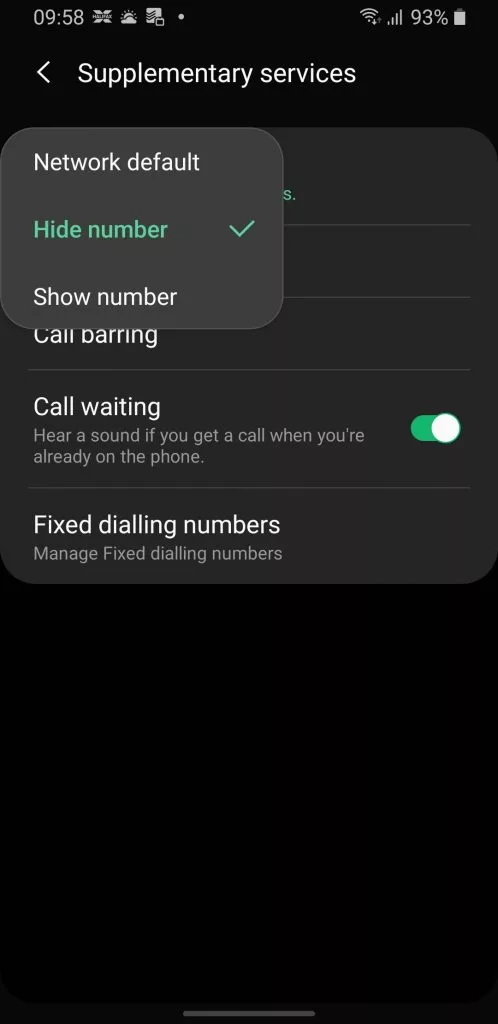
Do not untick the Caller ID and spam protection setting you may see at the top of the screen, which actually helps protect you from nuisance calls. Instead, scroll down and select Supplementary Services
Select Show caller ID and then select Hide number
There are a few things to beware of when switching off your caller ID:
Friends and family will no longer be able to tell it’s you who is calling, even if they have your number saved in their phone
Some residential call-blocking services may not connect you, because one of the default settings on many such services is to block calls from numbers withholding their caller ID
Emergency services or other organisations may not be able to collect your mobile number, meaning that they won’t be able to call you back if the line drops before you’ve given them your number
If you just want to make a one-off private call in the UK, I strongly recommend you read the above-linked article, which shows you how to do it by entering a series of digits ahead of the number you’re calling.
Another way to make private calls is to use a smart home device such as the Amazon Echo speakers or Google Home speakers, making sure not to enter your caller ID in the device’s settings. Here’s how to make free calls from the Google Home devices.
Barry Collins
Barry has 25 years of experience working on national newspapers, websites and magazines. He was editor of PC Pro and is co-editor and co-owner of BigTechQuestion.com. He has published a number of articles on TechFinitive covering data, innovation and cybersecurity.
To provide the best experiences, we and our partners use technologies like cookies to store and/or access device information. Consenting to these technologies will allow us and our partners to process personal data such as browsing behavior or unique IDs on this site and show (non-) personalized ads. Not consenting or withdrawing consent, may adversely affect certain features and functions.
Click below to consent to the above or make granular choices. Your choices will be applied to this site only. You can change your settings at any time, including withdrawing your consent, by using the toggles on the Cookie Policy, or by clicking on the manage consent button at the bottom of the screen.
Functional
Always active
The technical storage or access is strictly necessary for the legitimate purpose of enabling the use of a specific service explicitly requested by the subscriber or user, or for the sole purpose of carrying out the transmission of a communication over an electronic communications network.
Preferences
The technical storage or access is necessary for the legitimate purpose of storing preferences that are not requested by the subscriber or user.
Statistics
The technical storage or access that is used exclusively for statistical purposes.The technical storage or access that is used exclusively for anonymous statistical purposes. Without a subpoena, voluntary compliance on the part of your Internet Service Provider, or additional records from a third party, information stored or retrieved for this purpose alone cannot usually be used to identify you.
Marketing
The technical storage or access is required to create user profiles to send advertising, or to track the user on a website or across several websites for similar marketing purposes.
To provide the best experiences, we use technologies like cookies to store and/or access device information. Consenting to these technologies will allow us to process data such as browsing behaviour or unique IDs on this site. Not consenting or withdrawing consent, may adversely affect certain features and functions.
Functional
Always active
The technical storage or access is strictly necessary for the legitimate purpose of enabling the use of a specific service explicitly requested by the subscriber or user, or for the sole purpose of carrying out the transmission of a communication over an electronic communications network.
Preferences
The technical storage or access is necessary for the legitimate purpose of storing preferences that are not requested by the subscriber or user.
Statistics
The technical storage or access that is used exclusively for statistical purposes.The technical storage or access that is used exclusively for anonymous statistical purposes. Without a subpoena, voluntary compliance on the part of your Internet Service Provider, or additional records from a third party, information stored or retrieved for this purpose alone cannot usually be used to identify you.
Marketing
The technical storage or access is required to create user profiles to send advertising, or to track the user on a website or across several websites for similar marketing purposes.


