Trending Topics

 Trending
Why is my AirTag battery level low, even with a new battery?

Many early adopters of the Apple AirTag have reached the stage where the battery needs replacing. Thankfully, Apple makes the process very easy but some people find that, after replacement, the battery is still being reported as “low”. What’s going on and what can you do about it?
How to check the AirTag battery level
- Open the Find My app
- Tap on the Items tab
- Now tap the AirTag
- If the battery level is very low, “Low Battery” will appear under the name of the AirTag
How to change an AirTag battery
Before we get into the details of the problem, let’s run through the process of replacing the AirTag battery:

- Press down on the metal battery cover of your AirTag and rotate it anti-clockwise until the cover stops moving
- Remove the cover. You’ll see the battery underneath
- Remove the battery and insert a new one (you’ll need a CR2032 coin battery), with the positive side facing up
- You’ll hear a beep from the AirTag indicating that the battery has been connected
- Replace the cover, making sure that the three tabs on the metal cover align with the three slots on the AirTag base
- Rotate the cover clockwise until it stops moving
Once this is done, head into the Find My app and look up your AirTag. The previous “low battery” label should disappear. If it doesn’t then something about the above process hasn’t worked – check that you’ve done the above correctly (for example, ensure that the new battery is the correct way up).
If the AirTag didn’t beep when the battery was put in, then there’s something about the new battery that it doesn’t like. If it does beep then it may simply be a delay in the Find My app in updating the battery information, which should clear after a few minutes.
The AirTag battery is still showing as low. What can I do?
On the Apple website is a little footnote that may be relevant here:
CR2032 batteries with bitterant coatings may not work with AirTag or other battery-powered products, depending on the alignment of the coating in relation to the battery contacts.
Bitterant coating is often added to batteries to make them taste unpleasant if anyone attempts to put them in their mouth. Unfortunately, this same coating can sometimes prevent them from working as intended.
If we go back to our AirTag, without the battery, you can see the metal contacts that touch the bottom and edges of the battery:
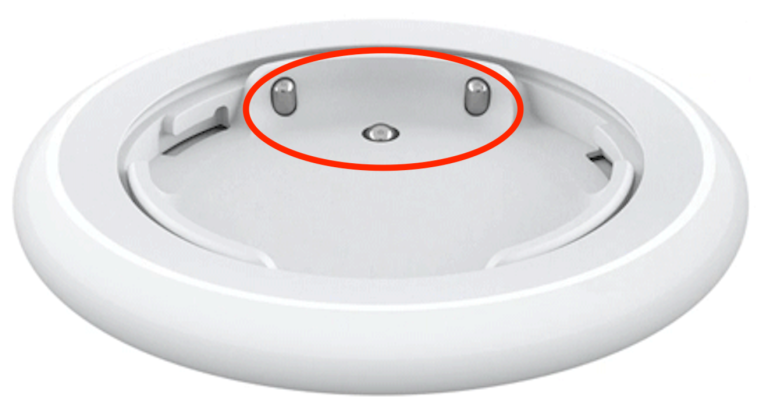
These just happen to sit where some battery manufacturers add their coatings.
So, if you’re still getting low battery warnings, check if your new battery has a bitterant coating – for example, Duracell button batteries usually do.
What can I do about these battery coatings?
You may be in luck if you have any alcohol wipes or alcohol-based cleaning solutions and a cloth. Firmly wipe the battery all over and this may be enough to remove the coating. When I experienced this issue with a Duracell battery, this technique worked. This time, when I put the battery in, the AirTag beeped to confirm, unlike when I’d done it previously.
That said, we can’t be 100% sure that wiping a battery with alcohol solutions won’t damage the battery, so you may be better off looking for batteries that don’t have this coating. For example, these Panasonic batteries don’t include a coating and offer excellent value for money.
Recommended reading: How to make Zoom calls on Apple TV 4K
What else could be wrong?
If you’ve tried all the usual fixes but your AirTag still reports a low battery, it’s worth considering a couple of less obvious issues.
First, take a close look at the AirTag’s internal battery contacts. Over time, they can accumulate a thin layer of oxidation, especially if the tag has been exposed to moisture, temperature swings, or hasn’t been opened in a while. Use a cotton swab very lightly dampened with isopropyl alcohol to clean the contacts. Make sure everything is dry before reinserting the battery.
Second, not all “new” CR2032 batteries are truly fresh. Batteries that have sat on shelves for years, especially budget or off-brand options, may already be partially depleted. If possible, test your replacement battery with a multimeter to verify it’s delivering at least 3 volts. Some users report success only after switching to a reputable brand like Duracell, Energizer, or Panasonic.
There’s also anecdotal evidence that iOS can sometimes get “stuck” on battery alerts. Even after the battery is replaced, the Find My app may show the same warning for days. Restarting your iPhone or resetting network settings (Settings > General > Transfer or Reset iPhone > Reset > Reset Network Settings) can sometimes trigger a proper refresh.
Finally, if the low battery alert persists for more than a few days and the AirTag still works normally, it might just be a cosmetic bug. Apple hasn’t officially acknowledged this, but several users report that after a week or so, the warning eventually disappears, without taking any additional steps.
This article was updated on the 11th of June 2025 with additional info on what might be going wrong.
About The Author

David Artiss
NEXT UP