Trending Topics

 Trending
Right to Repair USA: fixing the system one state at a time

The USA’s Right to Repair movement has achieved a significant milestone. In the past eight years, all 50 US states have considered Right to Repair legislation, marking a pivotal moment in the fight against planned obsolescence and disposable culture.
Advocates hope many of the 50 states will eventually enact Right to Repair into law, reflecting how corporate attitudes have shifted and how the public desires to fix the things they own.
TechFinitive has spoken to two of the Right to Repair movements most active proponents. First, Nathan Proctor, Senior Director at PIRG explains the significance of the 50-state milestone. Second, Kathryn Horvath, WashPIRG’s Zero Waste Campaign Associate, takes us inside the Washington state legislature to where she’s currently battling on the legislative frontline to get Right to Repair enshrined into law.
50 States: A cause for celebration
To reach this milestone has taken the combined efforts of countless individuals prepared to fight for the fundamental right to fix things. Nathan Proctor’s two decades with PIRG gives him forensic insight into why Right to Repair is important.
“America is a big place with a diverse set of political environments and interests,” he told us. “To be able to say that no matter who you are, where you come from, you just want to be able to fix your stuff is an idea that has relevance to basically everybody. Therefore it’s relevant enough to write legislation about it. It’s a mark of pride for everybody everywhere who just wants to fix their stuff”.
Why do states approve repair legislation instead of Congress passing a federal law?
“State level is where contract law tends to be regulated and Right to Repair legislation is around contracts,” said Nathan.
“It is an unfair and deceptive contractual practice to sell something and then withhold the ability to fix it. Also, manufacturers, through lobbying, put up resistance in Congress that is less pronounced at the state level, where we have better access to lawmakers and community members have more access. Repair is a grassroots issue and it’s a perfect opportunity for us to advance the cause at state level.
The Washington State Senate stands ready to pass SB 5423, the next Right to Repair legislation, potentially making it law.
Right to Repair USA: Inside the Repair Court
Kathryn Horvath recently testified to the Washington State Senate, playing a vital role progressing SB 5423.
“Our primary sponsor is Washington House of Representatives’ Mia Gregerson and we’ve been working on this for the past five years. Once you introduce a bill, it gets read by the legislators and referred to a committee”, Kathryn told TechFinitive.
“This year it was referred to the Environment and Energy Committee and once it gets heard, the public and other stakeholders can testify and speak directly to the legislators. That’s important for gaining public support.”
As states across the US debate and pass Right to Repair legislation, lawmakers consistently encounter the same arguments and counter-arguments. Activists like Kathryn and Nathan push for repair legislation in formal exchanges with anti-repair lobbyists. Frustratingly, previously quashed mistruths such as third-party repairers can’t be trusted are repeatedly thrown at legislators to prevent Right to Repair becoming law.
Inside Washington’s Senate room, Kathryn combats the tired anti-repair myths, countering with the overwhelming positives that fixing products bring. ”There’s so much data and information which can be easily misunderstood,” she said.
“The legislators aren’t all professionals and experts in this field, so they rely on us to give accurate information. If people give misrepresented information, it’s really important to have folks follow up with that more accurate information so that they can understand the truth of it.”
Nathan Proctor’s attitude to misrepresenting repair is refreshing. “There’s a consequence for tech industry lobbyists who make outrageous and silly arguments. In some cases, lawmakers don’t want to deal with them. If you are correct and you have the facts and you’re consistent and prepared, it’s just a matter of time before you win.”
Google ❤️s Right to Repair
In recent campaigns, the Right to Repair movement has received support from manufacturers, including Google. “We’ve recruited many critical voices and having a well-known manufacturer’s voice really rounds out what we’re trying to do,” said Nathan.
“To have a manufacturer say ‘everything that’s in this bill is compatible, ethical, possible and the right thing to do, and we think that these other opponents arguments are not credible’ is helpful. Splitting the opposition’s coalition so that they’re smaller makes it easier. That’s how I view Google support and we’re really grateful for that.
Do the US public want a Right to Repair?
Public support is vital. Kathryn and her team spend considerable time listening to the opinions of Washingtonians. “We canvassed in over 12 different legislative districts, speaking with thousands of people and gathering over 1,400 signatures from constituents in support of Right to Repair.”
This stage is critical because although repair delivers many science-backed benefits to society and the environment, ultimately Right to Repair will only become law with popular support. The positive news is that Kathryn has witnessed a change in people’s opinion.

“A few years ago, fewer people knew what Right to Repair meant, but we’ve realised that the public has really grown in awareness,” said Kathryn. “Even for folks who had never heard of it, because it’s such a commonsense solution, people are surprised it isn’t consumer protection that we have in place. I did not speak to a single person at the door who wasn’t immediately in support of the bill and that is really exciting. Right to Repair really has resounding support from people”.
How repair directly affects your life
Perhaps you’re wondering why repair is critical. Why should you bother fixing something when Amazon can dispatch a replacement via drone?
Repair is often cheaper and faster than replacements, but decades of manufacturer’s anti-repair practices have decimated fixers and removed the concept as the societal default. The ability to fix a device has real-world cost benefits against expenditure, on-boarding and disposal, but the major impetus for repair goes beyond any bottom line.
E-waste is the fastest growing waste stream on the planet. Why? We don’t have the technology to recycle or reclaim material for reuse at scale. Whilst companies remain unwilling to reduce their highly profitable outputs, keeping things we own in use for the maximum amount of time is better for your costs and the environment. The key to device longevity is repair.
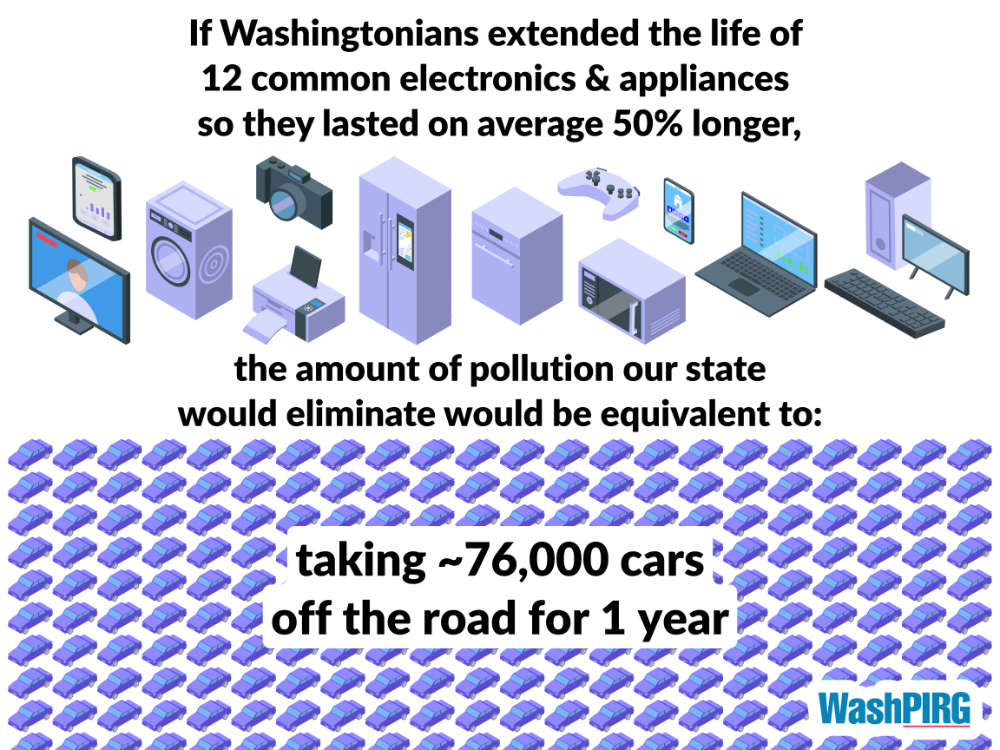
The PIRG has commissioned a report detailing the environmental benefits of repair and Kathryn Horvath sees the data as a valuable tool to illustrate important issues to the public. “If households in Washington kept their devices in use for one more year, it would save over $1.1 billion. It’s a lot of money, and emissions. We’re not saying never buy something new but just extend that lifespan a little longer and it has significant benefits. That’s really impactful for people to hear.”
The future of Right to Repair (USA and beyond)
The achievement of getting 50 states to discuss Right to Repair is remarkable, but there are many obstacles which could prevent the future bills passing into law. I asked Nathan what the future of Right to Repair looks like.
“We can now buy parts from Apple, which we couldn’t do before, but they’re expensive. How can we have more affordable parts pricing? That’s something that we need to think about. We need to make it easier for third-party companies to produce compatible tools, which means we need to change copyright law.”
He added that they have been at Capitol Hill in an attempt to convince lawmakers “to remove a provision in copyright law which makes bypassing a digital lock illegal, even if the purpose is legal”.
He adds: “Our goal is that there’s a vibrant repair ecosystem that everyone can fix things in the least troubling way. We’re just going to keep on innovating until we’ve convinced manufacturers they should make sure that those boxes are checked, so that we’re not in their hair.”
Kathryn Hovath is optimistic that Washington may pass Right to Repair into law soon “Our legislative session began in January but we’re hoping to get this passed out by April”.
Of course, TechFinitive will let you know what happens.
To learn more about the Digital Right to Repair Coalition, take a look at their fascinating report, The State of Right to Repair.
More articles by Lee Grant